October 2021 onward · Aberdeen to Colorado Springs
Why the 3M story spans South Dakota, Minnesota and Colorado
South Dakota — the workplace complaint. John Wingo worked at 3M’s manufacturing plant in Aberdeen, South Dakota. He reported racial harassment there. 3M’s answer places the end of his employment on October 18, 2021. John attributes his dismissal to reporting harassment. After he lost his job, he moved back home to Colorado Springs.
Minnesota — six federal lawsuits. John Wingo and the five other plaintiffs filed separate federal lawsuits in the U.S. District Court for the District of Minnesota. The Minnesota court heard the lawyers’ request to withdraw in October 2023 and dismissed the six civil cases on July 17, 2024.
Colorado — requests for help and police reports. By the time of the dismissal, John had been telling people in Colorado about the lawsuits for more than a year. From Colorado Springs, he could seek counsel, share the Minnesota docket with local officials and ask local agencies to investigate. The later police reports and citations concern events in Colorado Springs. The dated records show whom John contacted and what those offices recorded.
2022–2023 · Lakewood, Colorado, and Minnesota
John Called a Colorado Law Office About His Minnesota Case
Full record Read the licensing comparison and play the clip · Open the signed retainer and licensing exhibits
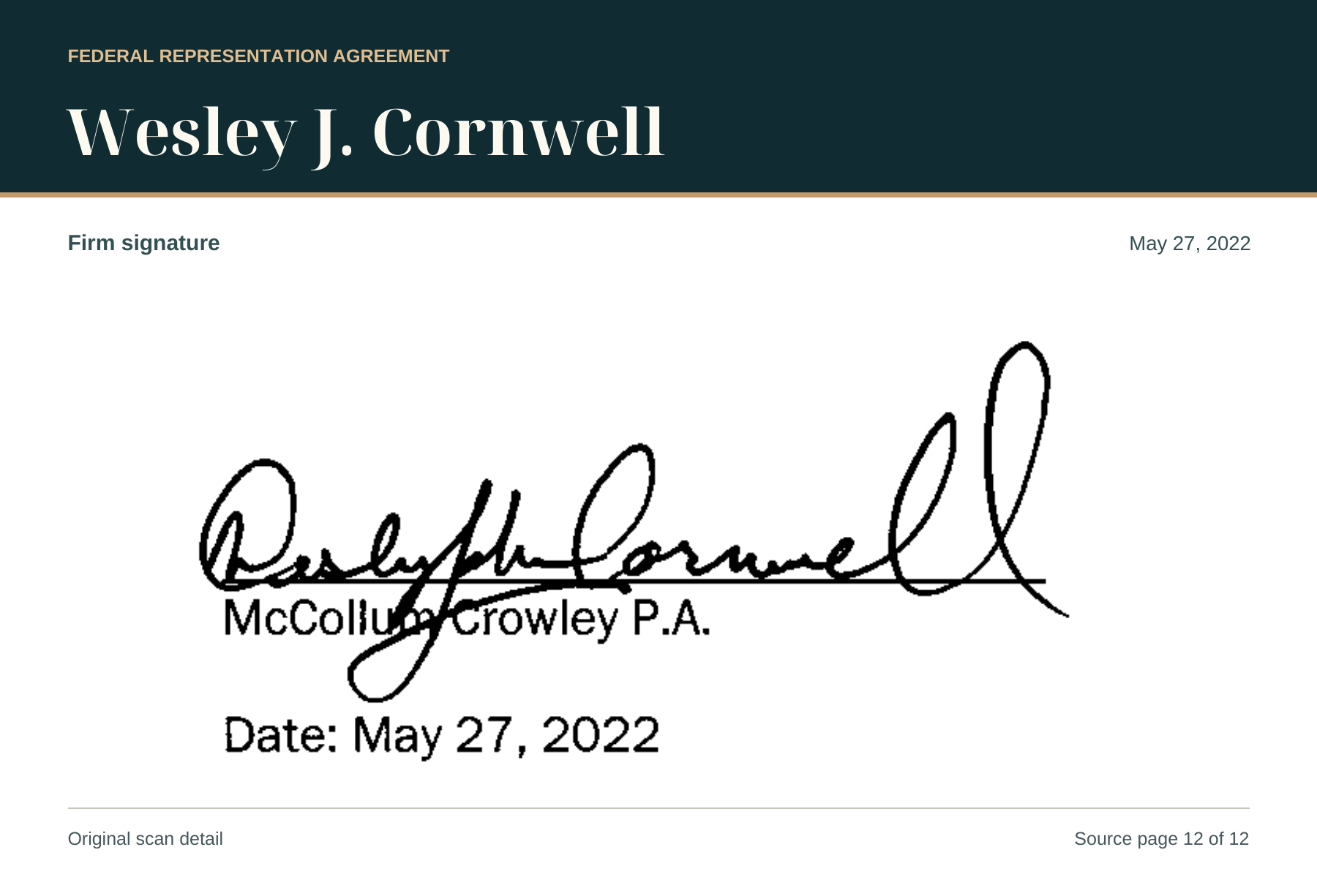
When the plaintiffs wanted new counsel, John contacted the Lakewood, Colorado, office of McCollum Crowley P.A. John recalls that Wesley J. Cornwell introduced himself as an attorney, asked for the case files and discussed whether the claims could be pursued in Colorado. John places the signing meeting in Minnesota. His own agreement, dated May 27, 2022, carries Cornwell’s signature for the firm on page 12.
John wanted to know what authority Cornwell had to speak for the firm. In November 2022 he signed an email to John as an associate attorney. In October 2023 Minnesota’s Office of Lawyers Professional Responsibility identified him as a paralegal. Cornwell later told Colorado’s attorney regulator that he was an associate attorney when he signed and that Minnesota rules authorized his actions. For John, those differing descriptions explain why he took the documents to authorities in Colorado.
Who answered John’s call, and what did the firm tell him when Cornwell left?
John Wingo called the firm’s Colorado office seeking new counsel. John says he understood that the cases would be moved to Colorado and traveled to Minnesota to sign on that understanding. Cornwell’s own response to Colorado regulators says the firm’s switchboard routed that first call to him. The written agreement identifies John’s existing Minnesota action. All six cases ultimately remained in Minnesota.
Check the dates in Cornwell’s account. In his December 20, 2024 response, Cornwell described John as seeking help with six cases already filed and dated the start of representation to May 27, 2022. Four complaints had been filed in April. Vaughn Wingo filed on July 28 and Nevely Randle on July 29. The May agreement therefore predates two of the six complaints. In Vaughn’s case the distinction matters twice. Manpower employed him at the Aberdeen plant, and he named 3M as the defendant when he sued over his treatment and the permanent position he sought.
March 7–8, 2023. John’s March 8 email records a call with Kluk the previous day about where depositions would take place and how the plaintiffs would pay for travel. It also records a call that morning with Kluk and Tomczik about Cornwell’s departure. John’s account attributes the statement about Cornwell lacking an attorney’s license to Tomczik. Kluk’s own March 8 email confirmed Cornwell had left, declined to give the reason and said the departure was unrelated to John’s case. John told them the first deposition was scheduled for March 23. He asked who would prepare the plaintiffs now that their principal contact was gone.
John sees concealment in the gap between the title the firm presented to him and the explanation he says he received only after Cornwell left. Cornwell used “Associate Attorney” in correspondence before the May 27 retainer and signed the agreement for the firm. Minnesota’s October 2023 disciplinary-office letter described him as a paralegal. The state register gives April 24, 2024 as his Minnesota bar admission date. Cornwell asserted that he had authority to do the work. Colorado later closed its inquiry for insufficient evidence of unauthorized practice in Colorado. The records establish what John was shown, what was filed and when he protested. They do not establish that Kluk ordered a cover-up or that licensing was the firm’s reason for ending Cornwell’s employment.
Representation records · Minnesota and Colorado
Wesley Cornwell’s 2022 role and his Minnesota bar admission
When John Wingo sought new counsel for his federal case against 3M, he understood Wesley J. Cornwell to be an attorney. On May 27, 2022, Cornwell signed the representation agreement for McCollum Crowley. Brian J. Kluk entered his appearance for John in federal court on June 7. The retainer and the docket identify who signed for the firm and who appeared for John.
The title John saw before Minnesota admitted Cornwell to the bar
On November 5, 2022, Cornwell emailed John about his written answers to 3M’s questions. Cornwell said the answers were already electronically signed and asked John to review them before service. His signature block read “Associate Attorney.” John asked the firm to send him the questions and records so he could see exactly what 3M had requested.
The Minnesota Judicial Branch lists April 24, 2024 as the date Wesley John Cornwell was admitted to the Minnesota bar, lawyer ID 0504965. The two state records preserved in Exhibit 2 give the same date. Both the May 2022 signature and the November 2022 email predate that admission. What authority did Cornwell have at the time, and how did the firm describe his role to John?
May 27 agreement · firm signature, p. 12 · June 7 appearance · ECF 15 · November 5 discovery emails · Official Minnesota registration · 0504965 · Exhibit 2 · two archived admission records
October 26, 2023 · Minnesota OLPR
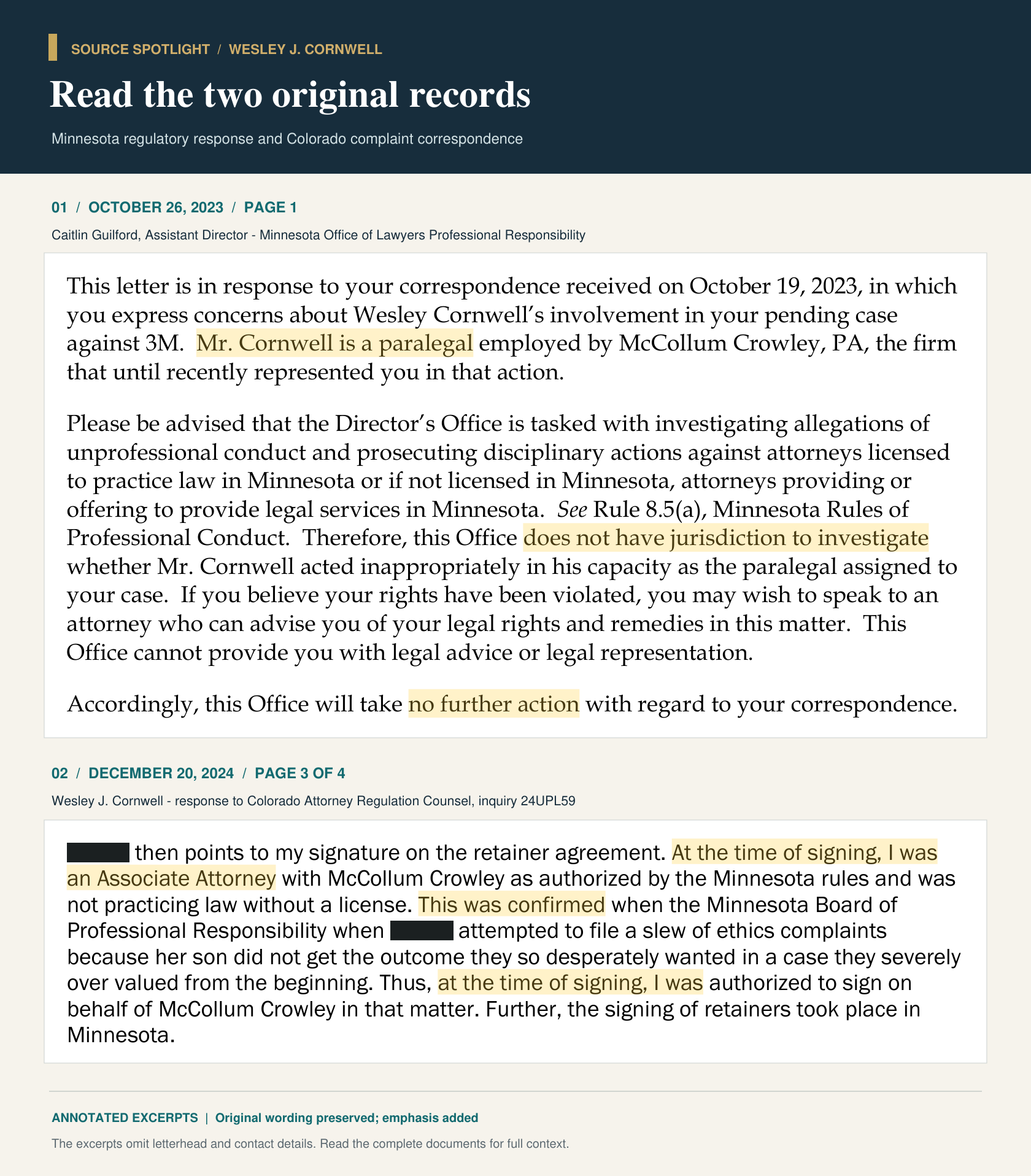
“Mr. Cornwell is a paralegal employed by McCollum Crowley, PA, the firm that until recently represented you in that action.”
Sources Minnesota response, page 1
December 20, 2024 · Cornwell’s Response
“At the time of this incident, I was authorized to practice law in Minnesota and in good standing without having a domicile in Colorado”
Sources Response in 24UPL59, page 1
Cornwell told Colorado regulators that Minnesota rules authorized him to sign for the firm as an associate attorney and that the Minnesota responsibility office had confirmed his authority. The October 2023 letter John received identifies him as the paralegal assigned to the case. It says the office lacked jurisdiction to investigate his conduct in that capacity and would take no further action. It makes no finding about his authority to use the title in 2022.
Colorado closed inquiry 24UPL59 on April 3, 2025. Its letter cited evidence that Cornwell held a Minnesota license by then and insufficient evidence to establish unauthorized practice in Colorado. The Minnesota registration record dates his bar admission. The Colorado closure addresses a different question about practice in Colorado.
Cornwell’s response · pp. 2–3 · Colorado’s closure · April 3, 2025
Why the title matters under Minnesota criminal law
In 2022, Minnesota Statutes § 481.02, subdivision 1, prohibited a person acting without applicable authority from holding himself out, including by letter, as qualified to give legal advice or act as an attorney. Subdivision 8(a) classifies a violation as a misdemeanor and assigns prosecution to county attorneys. The title on the November email is evidence of what the firm’s client saw. Determining whether its use violated the statute also requires establishing Cornwell’s authority on that date.
Minnesota’s supervised-practice rules allowed a certified law graduate to perform legal work under supervision. Rule 7 required the graduate to identify himself to the client as a supervised practitioner and proceed only with acceptance. Rule 5 made the supervising lawyer responsible for ensuring the client knew and accepted that role. Cornwell identified Kluk as lead counsel. Kluk’s name also appears on the August 8 disclosures. Those records identify a lawyer of record. They do not establish whether Cornwell held a certification covering the disputed dates or what John was told about supervision.
What would answer John’s question? A dated certification covering the May and November 2022 work, the supervising lawyer’s designation, and a contemporaneous communication showing how the firm explained Cornwell’s role to John. The records presented here establish the title, the admission date and the criminal provision. Neither regulator’s letter finds that Cornwell committed a Minnesota crime.
Minnesota Statutes § 481.02 (2022) · subdivisions 1 and 8(a) · 2022 Minnesota Supervised Practice Rules 5 and 7 · printed p. 1730 · August 8 disclosures · Kluk’s signature, p. 5 · Minnesota and Colorado practice standards
Key Segment · Cornwell Describes His Caseload
Wesley Cornwell says he’s had more than 100 cases and refers to more than 300 in his last two years. He doesn’t identify the cases or explain his role.
Why it’s here: His description of his workload belongs beside the retainer, appearance and licensing records above. Those records address the separate question of what he was authorized to do.
Captions, Source Times and Legal Terms
Captions: “I’ve had over 100. [unclear] Over 300 in my last two years.”
Source: 1:56.12–2:01.92 of the caseload recording (14:43.63–14:49.43 of the full recording). The unclear phrase is marked, not guessed.
Holding out means presenting yourself as authorized to act as a lawyer. Unauthorized practice of law concerns work reserved to an authorized legal practitioner or holding yourself out as qualified without the necessary authority.
Legal sources Minnesota Statutes § 481.02 · Colorado unauthorized-practice rules
Wire fraud requires an intentional scheme to defraud and an interstate or foreign wire transmission in furtherance of it. Caseload figures alone do not establish those elements.
Legal sources 18 U.S.C. § 1343 · archive’s legal standards
July 14, 2023 · Colorado Springs
John Sent the Federal Docket to the Mayor’s Office
John describes meeting Colorado Springs Mayor Yemi Mobolade at a coffee shop with members of his family. John recalls giving Mobolade documents about the six lawsuits. The dated follow-up is more precise about what John sent next.
On July 14, John emailed a campaign contact at 1:33 p.m. and the mayor’s city office at 1:39 p.m. He referred back to the coffee-shop meeting, supplied the federal docket link and asked for another meeting, a statement and a photograph. Both messages went out before the Minnesota court heard the attorneys’ motion to withdraw. The emails establish what John sent and when. An intake or forwarding record would identify who reviewed the material inside the office.
March 17, 2024 · Colorado Springs
Photographs of Shattered Vehicle Glass
A relative of lead plaintiff John Wingo reported that someone had fired at a member of his family. At 9:07 p.m. on March 17, a message in a thread labeled “Tony Exsum SR” shows two photographs of shattered vehicle glass. The sender identifies the contact as Colorado State Senator Tony Exum Sr. On March 22 at 11:05 a.m., a reply signed “Senator Exum” asked whether a report had been made and whether an officer came to the location. The response was “Yes. We did. Thank you”. The photographs document the damage. The exchange records the follow-up. Identifying a shooter or a motive would require the investigation records.
John also describes death threats, harassment and being run off the road. He believes speaking about the lawsuits put him and those close to him at risk. The source of a threat, the date police received a report and the actions they took are separate questions. The chapter returns to those questions after the police contacts and court records below.
June 2024–August 2025 · Colorado Springs, Golden and Lakewood
Taking the Cornwell Complaint to Police
June 24, 2024 · Colorado Springs, Before Dismissal
In a conversation John Wingo identifies as a meeting with Colorado Springs Police Officer Levi G. Braun, the officer explains why he recommended a report to the FBI in Denver. He could document incidents described in Colorado Springs. He said conduct in another state was outside his jurisdiction. John and his family also expressed concern that someone was tracking them. Later in the recording, the officer says he lacks evidence that anyone is actively tracking the phone at that time.
June 24, 2024 · 0:45–1:08
July 17 · The Golden Referral on the Day of Dismissal
On the day the Minnesota court dismissed the six lawsuits, John Wingo recalls visiting the First Judicial District Attorney’s Office in Golden with a relative. The relative says she gave Investigator Stacy Galbraith the Minnesota regulator’s letter and asked for a criminal investigation. A 4:52 p.m. referral text directed her to attorney regulation. John Wingo and a relative also reported their concerns to Lakewood police.
July 2024 · Who Had Authority to Take the Complaint?
In a separate 92-minute recording, the speakers discuss Wesley Cornwell’s work in the Denver area. One says the next call should go to Lakewood Police in Jefferson County. Another asks why the people making the complaint were told not to return. One speaker asks who files charges when someone presents themselves as an attorney.
John Wingo identifies this as a meeting involving Robert Koski, Officer Levi G. Braun and Colorado State Senator Tony Exum. The file carries a July 24, 2024 creation date. The excerpt begins mid-discussion. It establishes what was being raised before the July 30 follow-up. An appointment or attendee record would independently confirm the date and each participant’s capacity.
Opening 0:00–0:48 of 1:32:21
July 30 · The Call About Stacy Galbraith and the Lakewood Voicemail
The recording begins in the middle of a call. John Wingo identifies the woman on the line as Investigator Stacy Galbraith, whom he says he and a relative met at the First Judicial District Attorney’s Office in Golden. The speakers discuss Colorado’s Office of Attorney Regulation Counsel. One remembers a Lakewood contact card and says it could no longer be found. After the call, a voice in the room says, “I gave her that card.” The relative says she had also provided Minnesota’s attorney-regulation paperwork. The disagreement matters because it bears on what the investigator had available when John and his relative asked for help.
July 30, 2024 · 0:42–1:34
The recording then captures a second contact. After reaching Lakewood’s voicemail system, the caller identifies himself as a Colorado Springs police officer, refers to John Wingo and a relative and refers to a Lakewood report about Wesley acting as an attorney. Records supplied by John Wingo identify it as Lakewood report 24-022929. This portion preserves an outgoing message. To establish how Lakewood handled it, the next records would be the intake report, callback notes and disposition.
July 30, 2024 · 2:56–3:29
July 31 and August 5 · Current Licensing Versus Status at the Time
On July 31, Braun describes being told that Wesley was licensed. He explains why he kept asking about the earlier period covered by the complaint. He describes a referral to the attorney general’s office. One speaker tells him they have been going in circles between offices. Five days later the complainants ask again what became of their report. Braun recounts speaking with a civilian investigator, asking whether more paperwork would reopen the matter, and being directed back toward Minnesota. His account records what he relayed to the complainants. The receiving offices’ own records would establish their decisions and reasons.
July 31, 2024 · 0:00–1:05
August 5, 2024 · 1:16–2:12
August 14 · Which Papers Were Sent?
The next recording opens with a speaker describing two different descriptions of Cornwell’s role. One document described him as a paralegal. Other paperwork described him as an associate attorney. The speaker says materials had been sent and a response was pending. These are the same competing descriptions at the heart of the licensing complaint.
August 14, 2024 · 0:00–0:19
Dates on the five supplied recordings follow their file labels. The separate meeting file carries its own creation date. The duplicate July 31 and August 5 files contain the same audio for each date. Each player gives the elapsed time in the source recording.
August 16 · A Separate Charge Against Braun
John Wingo asks whether Braun faced repercussions for pursuing the complaint. Colorado Springs police dated the separate complaint about Braun to June 5, 2024, before the first of these five recordings. Police announced an official-misconduct charge on August 16. The announcement supplies no link between the charge and his work on John Wingo’s complaint. Read KRDO’s report of the police announcement.
September 4, 2024 · A Written Complaint About Police Follow-Up
In a letter addressed to Mr. Koski, a relative of John Wingo described trying to report an unwanted message about John. She wrote that she called Colorado Springs Police, went to the station when no officer was sent, and watched a request for service take shape where she had expected a formal complaint. She gave the call number, 2024-00331201. An officer later came to her home. According to the letter, he asked her to prove her concerns and recorded a service call. The letter preserves what she challenged at the time. The dispatch history, body-camera recording and incident classification would show how the department handled it.
Read the September 4 letter to Mr. Koski · excerpts
What Colorado’s Regulator Decided
In inquiry 24UPL59, the Colorado Supreme Court Office of Attorney Regulation Counsel asked for a response. Cornwell replied on December 20, 2024. On April 3, 2025, E. James Wilder closed the inquiry for insufficient evidence to proceed. John Wingo disputes the explanation of Cornwell’s role. The letter records the regulator’s decision. The retainer and competing accounts are available together below.
August 20, 2025 · The Search for a Record of the Reports
An August 20 records request concerns lead plaintiff John Wingo and his family. It identifies Officer Levi G. Braun and asks Colorado Springs Police for dispatch audio, incident reports, officer notes, body-camera recordings and logs for records destroyed or withheld. The request predates the October CPCD encounters by more than two months. The copy supplied here contains no response from the custodian.
Read the CSPD records request · excerpts from pages 1, 3 and 4
Fall 2025 · Colorado Springs and the Pikes Peak State College campus
A Request for a Child’s Records Became a Police Matter
Full record Compare the October 31 police and school records
John sought records about his preschool-age son from Community Partnership for Child Development (CPCD). John describes his consent as limited to speech services and asks who authorized an additional classroom observation involving Cheyenne Mountain School District 12. On September 5, Serena Johnson identified herself in an email as a behavioral health consultant at Pikes Peak State College and described providing support in the classroom. On September 22, CPCD family advocate Marcy Van Etten shared a list of outside speech providers and confirmed an October 13 home visit. Neither email gives the scope of John’s consent.
An invitation and cancellation establish an October 23 meeting date that did not go ahead. The recorded meeting about the child’s files took place on October 28.
- 2330 Robinson Street
- CPCD administrative office. John Wingo places the October 28 records meeting here. This is also where he says he and a relative returned on October 31.
- 5675 South Academy Boulevard
- Pikes Peak State College, Building 23. This was the child-development site and the location named in the October 28 afternoon dispatch record.
- 2335 Robinson Street
- Safe Passage Child Advocacy Center. Detective Sean Medina identified this separate address in his supplement to the October 31 police report.
October 28 · The Meeting and the Campus Call
In the meeting recording, John Wingo and a relative ask why District 12 was involved and request the document authorizing access to the classroom. Staff discuss the child’s home district and a consent form. In the 20-second excerpt, a participant asks who gave permission. A staff member identifies the form as EN103 and says it should have been uploaded. The dated consent form and any observation log would show what was authorized and what actually took place.
Later that day, dispatch incident 2025-00203694 classified a call at the college as criminal trespass in progress. At 3:48 p.m., the notes place a relative of John Wingo outside the child-development center. By 3:50 p.m., the caller said campus police were already speaking with the subject. The relative says staff released the child to her and disputes the trespass account. The dispatch classification records how the call entered the system. The original call, officers’ body cameras and child-release log would allow a closer comparison.
Hear Who Authorized Classroom Access
Read the Excerpt Transcript
- 0:00Questioner: Okay, so who gave that permission?
- 0:01Staff: From a conversation from D12 that reached out to our director.
- 0:05Questioner: So who gave them that permission?
- 0:06Questioner: D12 was not his parent? Staff: So on the form, we had an EN103 that the
- 0:11Staff: classroom staff had a parent sign that said D12 could come in.
- 0:15Staff: It should be uploaded on there.
- 0:17Staff: I do know that my team did that.
- 0:18Staff: [It] was the only way they could come in.
October 29–31, 2025 · Robinson Street
What the School Letter, Trespass Notice and Citations Say
Two people separately described a scheduled October 31 meeting to Colorado Springs police. Officer Carlos Espinoza recorded CPCD Child Development Director Dr. Shana Lachowicz’s account that the meeting was intended for the parents. Detective Sean Medina recorded the child’s grandfather, Ernest Wingo, describing a 10 a.m. appointment. The family dates the scheduling call to October 30. The police accounts establish that a meeting was scheduled. Whether the school promised to hand over the file that day remains unresolved.
What Kenoyer reported seeing. In his October 31 supplement, he wrote that from across Robinson Street he saw John pushed away and saw him kick the doors. On November 4 he described seeing a shove and kick on Safe Passage security footage. John disputes the property-damage charge. The short Axon excerpt shown in the archive begins after the doorway contact.
Compare the officer accounts · CSPD pp. 7, 11–12, 15–17 · Watch the 63-second documentary
When Was the Trespass Notice Delivered?
CPCD’s letter bears the date October 29 and refers to an October 28 incident. In case 2025-00416573, Officer Carlos Espinoza recorded CPCD supervisor Layna Mendes’s statement that a letter had been issued October 28 and the recipient had been notified. He also recorded the recipient’s denial of receipt and entered a printed letter into evidence. The date on the letter and the date of delivery are distinct.
Who Received Which Citation?
Officer Carlos Espinoza issued John Wingo municipal summons E1481688 for one count of damage to property. Espinoza’s disposition lists a separate trespass citation for Felicia Wingo. Detective Trevor Kenoyer’s supplement describes John as cited for both offenses. John’s issued ticket shows exactly where the accounts differ.
John’s account and the body-camera excerpt · Compare the transcribed summons and police report fields
What Happened to the Child-Safety Report?
John Wingo and a relative identify CPCD in their account of the concern they raised. Detective Sean Medina separately recorded a relative raising a concern about the child and listed the suspected person as unknown. The record documents a report. A referral number, intake decision and follow-up record would show what happened next.
Who Left the Campus with the Child?
John Wingo says both grandparents, Felicia and Ernest, were listed to pick up and care for his son. Felicia’s account, preserved in the family’s CPCD chronology, is that she had picked him up before and the child was released to her. The October 28 morning campus dispatch (2025-00203425) closed at 10:56 a.m. as “Resolved Onscene.” A separate afternoon pickup call (2025-00203694) was classified as a trespass in progress at 3:47 p.m. That label records what dispatch received. Neither entry identifies the names on the authorized pickup list.
The October 29 CPCD letter and the October 31 administrative-office meeting raise a different question. The written restriction names Felicia. John disputes notice and maintains that his parents had authority to collect his son at the college. The officer’s later account of who could enter the office that day distinguishes John from both grandparents. Whether the family received the notice, its reach at the college, and the terms of the pickup authorization remain disputed.
Dispatch and court record excerpts · October 29 notice, p. 1 · Officer’s account of the entry instruction
Detective Whitney Barrett recorded a staff account that campus police received the child and handed him to his father in the earlier incident. The October 28 dispatch notes record an officer speaking to a person outside. They do not identify the adult who ultimately took the child home. The release log and campus footage would answer that question.
Where the 3M Case Appears in the Police Report
On D01A8351S, at 10:44–10:59 elapsed, the interviewer asks John whom he sued. John answers “3M Company.” In a separate recording, officers discuss a race discrimination lawsuit and one tentatively identifies Minnesota. Together with Medina’s supplement, these exchanges show how a federal workplace case entered a local police conversation about a school-records dispute. John asks why officers pursued the subject and whether it influenced the tickets. The speakers give no instruction in either excerpt to charge him because he sued 3M.
John’s recorded answer · Officers’ separate conversation
A relative of lead plaintiff John Wingo named Officer Levi Braun and discussed John’s 3M case with Detective Sean Medina during the October 31 response. Medina recorded both details in his supplement. He also wrote that the relative did not give a specific explanation linking the earlier events to this disturbance. This places the federal case inside the Colorado police record in the detective’s own account. It leaves open what information other officials had before responding or issuing citations.

Two other details matter when comparing reports with video. Espinoza recorded that he had yet to review his body-camera footage when writing his report. Kenoyer later described a review of Safe Passage footage whose displayed times differ from the time in his on-scene account. The original footage and the camera clock setting would let a reviewer align those events.
Which Education Records and Consent Rules Apply?
For a public agency’s initial special-education evaluation, the Individuals with Disabilities Education Act regulations generally require informed parental consent. A participating agency must allow a parent to inspect education records it collects, maintains or uses under Part B without unnecessary delay, before specified meetings or hearings, and within 45 days of the request. The signed consent, proposed assessment and records received by each agency would show which requirements apply here.
Head Start also provides a parental right to inspect child records. Its rules specify when FERPA or IDEA confidentiality provisions govern instead. Identify the institution holding the record and the child’s referral status before applying a deadline.
34 CFR § 300.300 · parental consent · 34 CFR § 300.613 · access to records · 45 CFR § 1303.21 · applicable confidentiality provisions · 45 CFR § 1303.23 · Head Start inspection rights
2026 · El Paso County and Colorado Springs
The County Filing, the Settlement Statements and the Defense
Full record Hear the statements and see the payment questions
What the two offices said about a settlement
John denies accepting, cashing, transferring or receiving a 3M settlement payment. In a recorded defense meeting, Dillon Taunton, then with the Colorado State Public Defender’s office, told John it appeared he had received a settlement. John and a relative immediately disputed that account. The recorded exchange preserves Taunton’s statement that it appeared John “got a settlement out of that,” the repeated answer “No,” and his question about what happened to the case.
In a separate recording, a speaker John Wingo identifies as Jeff Anderson of U.S. Representative Jeff Crank’s office discusses what he understood about an offer. Senator Tony Exum is mentioned. An offer, an executed settlement and a payment are three different events. An agreement, disbursement authorization, trust-account entry and cleared payment would identify whether money moved and to whom. The recordings explain why John is asking where the story of payment began.
The Colorado Cases and the Request for the Child’s Records
John Wingo’s chronology identifies John’s El Paso County matter as 2026M5068. In the defense recording the speakers refer to a hearing on “the 10th.” John Wingo identifies it as September 10, 2026, and seeks the hearing log and recording. A relative says her charges were dropped and her case sealed after she asked Judge Meredith Patrick Cord to recuse herself. John reports that his own matter continued before a different judge. The respective docket entries and orders would establish each procedural step and its date.
On October 22, 2026, defense investigator Laura K. Esqueda requested the child’s records from CPCD and enclosed a release. Her November 3 email confirms that she sent the request. A delivery or production log would establish which records CPCD provided in response.
Across the chronology · Evidence of notice
Why John Believes the Colorado Incidents Were Connected
There are connections a reader can trace now. John sent the Minnesota docket to the mayor’s office. A relative says she carried the Minnesota regulator’s letter to Golden. Braun mentioned a Lakewood report during his follow-up. On October 31, Detective Medina recorded a relative naming Braun and discussing John’s 3M case. Later, the Minnesota settlement question surfaced in a Colorado defense conversation. Each identifies a person, a document or a conversation that crossed institutional lines.
Lead plaintiff John Wingo is asking whether officials shared information or used it to target him and his family. The July 2023 email documents outreach. It cannot tell the reader who saw it afterward. A referral records a decision to send someone elsewhere. It does not show who later accessed their file. Routing records, report histories, dispatch revisions and access logs could connect those steps to particular decisions. John is seeking an investigation that compares those records.
Colorado source collections
Read and Listen to the Underlying Records
Open a collection to see the documents and recordings behind a specific part of the story.
Wesley J. Cornwell · The Signed Retainer and Licensing Records
May 27, 2022 · Wesley J. Cornwell’s Signature
Wesley J. Cornwell’s signature appears above the printed name of McCollum Crowley P.A. The firm’s signature block is dated May 27, 2022.
Cornwell’s signature · PDF · Section 9.2 · Fee excerpt
One Signature, Different Descriptions of the Signer
John recalls calling the firm’s Colorado office about the Minnesota suits and understanding Cornwell to be an attorney. On October 26, 2023, Minnesota’s Office of Lawyers Professional Responsibility identified Cornwell as a paralegal at the firm. It said it lacked jurisdiction over a paralegal and would take no further action. In his December 20, 2024 response to Colorado, Cornwell said he was an “Associate Attorney” at signing, acted under Minnesota rules and worked with lead counsel Brian J. Kluk. The Minnesota letter gives its reason for declining the matter. It contains no finding that Cornwell held the title he later claimed.
John Wingo also disputes the account of supervised practice given to Minnesota regulators. A supervisor’s designation, authorization covering the dates of the work, court appearances and billing records would allow readers to check who had authority for each task. The signature, job titles and day-to-day responsibilities are distinct pieces of evidence.
The Two Regulatory Proceedings
Minnesota addressed a professional-responsibility complaint. In Denver, the Colorado Supreme Court’s Office of Attorney Regulation Counsel opened inquiry 24UPL59. E. James Wilder requested a response in November 2024. Cornwell responded in December. The April 3, 2025 letter closed the inquiry for insufficient evidence to proceed. Read the letters in date order. The reading copies omit private address information.
- October 26, 2023 · Minnesota OLPR letter
- November 6, 2024 · Colorado’s request for a response
- December 20, 2024 · Wesley J. Cornwell’s response
- April 3, 2025 · Colorado’s closure letter
Compare the passages side by side · Marked Minnesota letter · Marked Colorado response
Minnesota’s practice statute in 2022 · District of Minnesota admission rule
View Wesley J. Cornwell’s signature
July 30, 2024 · Recorded Follow-up Involving Levi G. Braun and Stacy Galbraith
John Wingo and a relative identify Officer Levi G. Braun of the Colorado Springs Police Department, Colorado Springs, Colorado, as the officer helping them pursue the complaint. They identify the opening telephone discussion as his contact with Investigator Stacy Galbraith after their report.
A relative of John Wingo disputes the account of what she supplied to Stacy Galbraith. She states that she provided the Minnesota OLPR documentation and other evidence. In the supplied recording, a speaker discusses a Lakewood contact card that could not be found; the in-room exchange that follows includes “I gave her that card” and a dispute about having given it to her. The recording then captures an attempt to contact Lakewood Police.
JULY 30, 2024
Follow-up on the Cornwell Complaint
Automated transcript · Unclear and overlapping words are marked. The supplied recording begins during a conversation and ends during a voicemail. The audio controls if a caption differs.
Read the source July 30, 2024 — Complete Complaint Follow-Up Recording (audio)
The Lakewood Card
The telephone discussion turns to a Lakewood card and a possible case report number.
The Immediate Response
In-room voices dispute the account of the card. Overlapping speech is marked in the transcript.
The Officer’s Voicemail
The caller identifies himself as Officer Braun with the Colorado Springs Police Department, refers to John Wingo and a relative, and gives report 24-022929.
“who is operating as an attorney but does not have a license to do so.”
Officer’s description of the concern in the voicemail · approximately 03:21–03:26
The audio records an officer pursuing follow-up on the complaint and John Wingo’s dispute over what was supplied. The opening telephone participant is identified as Stacy Galbraith by John Wingo; this excerpt contains no full self-introduction by that participant. The dispute audible here concerns the Lakewood card rather than an express statement that no evidence of any kind was provided.
Read the Full Timestamped Transcript
Automated reading aid, compared across two local transcription passes. Unclear and overlapping speech is marked; the recording controls if the text differs. Select a timestamp to play that point in the recording.
- 00:00Counsel, the Office of Attorney, yeah, Office of Attorney Regulation Counsel,
- 00:05they handle licensure grievances of attorneys and law firms.
- 00:10Okay.
- 00:12So I believe that that counsel would be the ones responsible for, you know, the
- 00:17decisions made in that law firm and the
- 00:19agents that they employ and the decisions made.
- 00:22Right, right. Yeah, so it's my understanding that if you have somebody who's paralegal
- 00:25or otherwise, but they're not licensed to be an attorney they're operating under the
- 00:30attorney or the firm's license so then they can be held liable to some degree.
- 00:37Okay. Does that are you tracking the same thought process I am?
- 00:41Yeah um yeah so see I think she had she had a card from
- 00:47Lakewood initially when we were talking and then she couldn't find it again so she may
- 00:52have an actual case report number okay for Lakewood to help get to that
- 00:58agent. Okay. Yeah. I will I will look into getting that case
- 01:04[unclear] / that individual that they spoke to.
- 01:07but I do appreciate you taking my phone call.
- 01:10Yeah. Yeah. Of course. I don't think I have anything else unless you have something for
- 01:15me. No, I’m good. Okay. Well, I do appreciate
- 01:18it and you have a good rest of your day,
- 01:19okay?
- 01:20Alright, take care. Alright.
- 01:23[Overlapping speech] I gave her that card.
- 01:26[Unclear] I got it on my phone. It's a text message.
- 01:29I gave it to her. It's right there.
- 01:30Yeah, it's right there.
- 01:32I still have it.
- 01:34Um. I gave all of it to her.
- 01:37[Unclear]
- 01:39She said I couldn't find it and I gave it to her.
- 01:40I was writing her a text. Like I said, we're here.
- 01:44Um, so now I'll call this person. Um, could you bring up.
- 01:49[Unclear] Yeah, so I’m guessing it’s gonna be the [number unclear] with the extension.
- 01:53I don’t know though.
- 01:56[Unclear] where that case is at.
- 01:59He wasn’t gonna do anything. He said he was [unclear] straight up to a—
- 02:03[Overlapping speech]
- 02:06[Unclear] I call him up on my speakerphone just
- 02:09like before, and if you guys just sit in
- 02:11the background.
- 02:13[A telephone number is read aloud.]
- 02:21Yeah, but I have to call it first right
- 02:23before I punch in the extension, so let me do
- 02:25that.
- 02:29You've reached the City of Lakewood voicemail system.
- 02:31Please dial the extension you would like to leave a message for.
- 02:34To dial by first name, press 1. To dial by last name, press 2.
- 02:42Your call is being forwarded to a Mitel voicemail system.
- 02:47Agent [name unclear] is not available.
- 02:49Please leave a message at the tone.
- 02:52When finished, you may hang up or press pound for additional options.
- 02:57Hi, I believe Detective [name unclear] , this
- 02:59is Officer Braun with the Colorado Springs
- 03:01Police Department. I'm reaching out to you because I recently was brought on to some
- 03:06[Names omitted]
- 03:10I believe they made a report with you up at Lakewood.
- 03:12I believe the case report number would be
- 03:1424-022929.
- 03:18In regards to an individual by the name of Wesley
- 03:21who is operating as an attorney but does not have a license to do so.
- 03:26I have a couple questions.
- 03:27I’d be greatly appreciative of you calling.
3M Settlement Questions · Statements, Audio and Payment Records
Colorado · Public-defender meeting
Dillon Taunton’s Statement and the Immediate Denial
John Wingo identifies public defender Dillon Taunton as the speaker. At about 0:30–0:44 he says it appears John “got a settlement out of that.” John and a relative immediately say no. The exchange records what Taunton believed. John wants to know which source led him to that belief.
Listen to the question and response from the defense meeting.
Same meeting · Colorado
The Hearing On “the 10th”
At about 3:08–3:43 the speakers discuss a hearing on “the 10th.” John Wingo identifies it as September 10, 2026. The dated court notice, hearing log and recording would resolve precisely which proceeding they meant. Elsewhere in the meeting they discuss withdrawal, separate lawyers and possible coordination.
Colorado Springs · Congressional-office contact
Jeff Anderson Describes an Offer
John Wingo identifies a speaker as Jeff Anderson of U.S. Representative Jeff Crank’s office. He describes what he understood about an offer. Senator Tony Exum is mentioned. A statement attributed to someone through another speaker establishes a different fact from hearing that person speak directly.
What Was Reported About a Settlement Offer?
This recording supplied for the project contains a statement that a speaker had been told of an offer, followed by John Wingo’s disagreement. The conversation does not establish an accepted settlement agreement, a disbursement or receipt of money. The original filename mentions Tony Exum, but the file title alone does not identify him as a speaker.
Read Timed Captions
Automatic captions; [unclear] marks uncertain words.
- 0:00[unclear] you're not, you're not [unclear] You're talking crazy.
- 0:03[unclear] and my mom, like, me and my mom are not against you.
- 0:06sit here and tell me that you think we got paid and I'm down here begging y
- 0:09'all to pay my utility. [unclear] fuck?
- 0:11I'm telling you that I was told.
- 0:13What settlement [unclear] we [unclear] get?
- 0:15That you were offered a settlement.
- 0:16No. that [unclear] be in trouble, we're going in too.
- 0:21What the fuck settlement we [unclear] We out here fighting like this.
- 0:23Nobody's coming up [unclear] haven't My son's been abused.
- 0:26DHS ain't showed up. Police ain't showed up.
- 0:28Nobody showed up. We're just up there fucking about [unclear] die and you
- 0:31motherfuckers just sit in here acting like [unclear] you go?
- 0:35[unclear] fuck
- 0:38What's going on is I'm de -escalating this because you guys are [unclear]
- 0:43we got money and we don't what the fuck is going on [unclear] I'm to
- 0:48understand what took place [unclear] down
- 0:53[unclear] is Friday you the Democrats is lying to you [unclear] got to
- 0:57believing that their church members [unclear] this [unclear] that and they're
- 0:59fucking you. Come on. Come on republicans
- 1:16[unclear] got it. got it But when your kids [unclear] looking like that and
- 1:21your windows are getting shot at you're on i -25 and cars are running until
- 1:24you [unclear] rekt in the insurance covers it up like [unclear] be scared
- 1:29I'm not scared that's why they lied
- 1:34to they got you they got you they got you in the newspaper looking
- 1:39like you're a fucking liar that you living over here you're not even in
- 1:42addition got to look like shit you shouldn't even be in the office that's how
- 1:44these [unclear] got you looking I ain't scared of [unclear]
- 1:53[unclear] gonna do that to me.
- 1:56[unclear] ain't gonna.
- 1:58Tony Exum, I got it, I got it, I got it, I don't [unclear] Exum lied to you.
- 2:02Tony They lied on you. Tony Exum is working with - Polish,
- 2:07Griswold, all of them.
- 2:10[unclear] Yami is corrupt.
- 2:12He's working with Yami.
- 2:14They got people gang [unclear] us, trying to kill us.
- 2:16And I'm sorry, I'm not trying to be disrespectful to any of you guys.
- 2:18That's why we're down here for help, I'm here.
- 2:21I'm not down here with these Democrats who need death, [unclear] needs to be
- 2:24sent to [unclear] fucking jail?
- 2:26need to be sentenced to death [unclear] what they have done.
- 2:29I'm not down here [unclear] for my [unclear] down here needing you guys'
- 2:32help. We are for Trump. We are for America.
- 2:35We are, we're good people.
- 2:36We don't do this, but they're messing with my kids.
- 2:40We're [unclear] people.
- 2:43We're coming to you. We're coming to down here asking.
- 2:48We don't ask people for money.
- 2:50We're not on the social media telling people for money to get to this point.
- 2:54We've been fighting. We're the reason for Minnesota.
- 2:55We was flying to Minnesota getting Friday that the FBI said,
- 3:00[unclear] cash, telling them can't tell conclusion that it was domestic
- 3:04terrorism to what happened to us out there.
- 3:06we still don't beg people for money.
- 3:08We still don't pay people for help.
- 3:09We show up to these courts in front of these judges [unclear] with nobody
- 3:12[unclear] no backing. Somebody don't [unclear] installed our identity and I'm
- 3:17positive of it.
- 3:19[unclear] to call [unclear] identity had been stolen.
- 3:22Me and my son [unclear] somebody's running around acting like us.
- 3:26I know it was to this extent.
- 3:28didn't know it was to this extent.
- 3:29So what's happened is we found out, let me tell you.
- 3:32Go down here to Koski. Y know who Koski is over here at district attorney's
- 3:36office?
- 3:37About three weeks ago, I got a call that I was supposed to be in court on a
- 3:42child abuse case, and it was fraud.
- 3:45I didn't know [unclear] they told me that they were [unclear] come arrest me.
- 3:47They told me it had something to do with Koski.
- 3:49was [unclear] jumped up and ran down there to cost [unclear] the Republicans
- 3:54were like Michael Allen [unclear] me in jail.
- 3:56What are you doing? guy called me back on the phone.
- 4:00I can't cost me my phone to talk to the guy.
- 4:04Johnny. [unclear] said he was going to put me in jail in Minnesota to protect
- 4:08the Democrats.
- 4:09These people ain't playing y 'all sitting around in this office thinking it's
- 4:13lolly dolly. These Democrats fucking kicking in your [unclear] And that's why
- 4:16they running shit.
- 4:18We're [unclear] motherfuckers they are powerful they rich they doing all that
- 4:22and they got people scared out of their mom these people are scared these
- 4:25people are scared [unclear] Tony [unclear] has come to you you need
- 4:30to probably do an investigation report it to the FBI go to the FBI
- 4:37regina english and what's [unclear] name uh [unclear] all came together to
- 4:41do that hope that they do when they [unclear] that [unclear] not black he's
- 4:44african i'm not african i'm american Don't [unclear] us [unclear] don't
- 4:49fucking put us away, [unclear] are not in me.
- 4:50[unclear] never been to Africa, don't know [unclear] shit about Africa, I'm
- 4:53not [unclear] to. Fuck Africa.
- 4:55Burn this shit down, for all I can give [unclear]
- 4:58Protect America, protect these American kids.
- 5:00I'm sorry, I'm [unclear] to go outside and just relax.
- 5:03Because [unclear] damn, mom they scared, they scared mom.
- 5:06So, whatever [unclear]
- 5:09[unclear] that [unclear]
Read Two Phrases from the Offer Discussion · 0:11–0:17
Selected phrases only. Use the timestamps to hear their context.
Sources: Play / download listening copy · Jeff Anderson discussion · Original audio · Records needed to verify payment
Minnesota and Colorado
What Would Establish a Payment?
An executed agreement would identify the parties and their terms. A payment authorization, insurer or company remittance, trust-account entry and disbursement record would show whether money was issued and who received it. No such payment trail appears in the records cited here. The federal dismissal order gives failure to prosecute as the reason the cases ended.
John Wingo’s position: He says he never accepted, received, cashed or transferred any settlement money from 3M.
Disputed Police and Education Records
Compare the Versions of the October 31 Police Account
The El Paso County Court filing in case 2026M5068 identifies John’s original ticket, E1481688, as the companion summons. It lists one criminal-mischief charge, records June 22, 2026 as the service date and bears a July 24 filing stamp. It names two police officers. The form leaves open who approved the rewrite. One supplement identifies Axon Draft One as a drafting aid and records officer review. The report also contains “Merged By” fields. Those fields identify steps in preparation. They alone cannot show who originated disputed wording or whether an edit changed the substance.
October 31 reports and child-safety concern · From city ticket to county filing · Read the selected charging fields and source page numbers
Education Records, Consent and Access
For each disputed visit or evaluation, the dates on the consent form, the service actually provided and the institution that maintained its records matter. The recording of the October 28 meeting and the later records request document two attempts to obtain answers.
Meeting and campus chronology · Federal special-education record access rule, 34 CFR § 300.613
The Colorado Offices and People in the Record
Colorado Springs and the State Government
John wrote to Mayor Yemi Mobolade’s campaign contact and city office in July 2023 while the Minnesota cases were active. In January 2024, Kurtis T. Morrison, then Colorado Deputy Attorney General for Intergovernmental Affairs, asked which reported events had taken place in Colorado. The exchanges identify offices that received the concerns. What those offices did afterward is a separate question.
Read the dated Colorado outreach records · Mayor’s office · Colorado Attorney General’s Office
Who contacted Representative Ilhan Omar’s office?
John Wingo sought a meeting with Representative Ilhan Omar’s office in Washington and identified himself and his mother, Felicia Wingo, as the intended attendees. On February 1, 2024, district office manager Frances Blee replied to Felicia. She confirmed that the Washington office had forwarded the request, explained that the office could not intervene in legal matters and referred them to Minnesota Attorney General Keith Ellison. This correspondence documents a request for assistance after the withdrawal. The original law-firm intake was John’s earlier call to McCollum Crowley.
Who Handled the July Contacts?
John Wingo describes a July 17, 2024 visit with Stacy Galbraith at the First Judicial District Attorney’s Office in Golden, followed by a report to Lakewood police about Cornwell. He identifies Lakewood report number 24-022929. Later that month Colorado Springs Police Officer Levi G. Braun followed up. The First Judicial District serves Jefferson and Gilpin counties. El Paso County belongs to the Fourth Judicial District. Those offices can receive different records even when a complaint concerns the same conduct.
Hear the Colorado follow-up · First Judicial District Attorney’s Office · Fourth Judicial District Attorney’s Office
The People Named in the Settlement Account
John Wingo identifies Colorado State Senator Tony Exum as the person Jeff Anderson referred to when discussing a reported settlement offer. Readers can compare Anderson’s words with the separate account of Dillon Taunton’s statement and John’s denial. Neither statement identifies a disbursement or its recipient.
Compare the settlement accounts · Colorado General Assembly biography
Colorado Offices, the Campus and Safe Passage
Who Could Receive a Report?
Yemi Mobolade was mayor of Colorado Springs when John sent his July 2023 emails. Tony Exum Sr. represented Colorado Senate District 11. Both held elected office. A message asking an elected official for help documents a different step from a police intake, an attorney-discipline inquiry or a prosecutor’s charging decision. Colorado Senate roster, 2024.
John Wingo places the meeting with Investigator Stacy Galbraith at the First Judicial District Attorney’s Office in Golden. That district serves Jefferson and Gilpin counties. The audio also refers to the Lakewood Police Department, a separate city police agency. Officer Levi Braun identifies himself with the Colorado Springs Police Department. The Fourth Judicial District Attorney’s Office serves El Paso and Teller counties and employs its own investigators. To trace a referral between these offices, look for the receiving agency, date, case number and disposition. First Judicial District overview · Fourth Judicial District investigations division.
Why the Campus and Robinson Street Both Appear
Pikes Peak State College records when the partnership began. In fall 2022, Community Partnership for Child Development began providing child care in the former Child Development Center on the college’s Centennial Campus, at 5675 South Academy Boulevard. CPCD also lists an office at 2330 Robinson Street. The distinction matters when matching a call, officer or request for footage to the building where it happened. College security report, campus description · CPCD’s offices and partners.
Which Agencies Work Together on Child-Abuse Reports?
Safe Passage, the children’s advocacy center, identifies Colorado Springs police, the Fourth Judicial District Attorney’s Office and El Paso County Human Services among its multidisciplinary partners. Colorado’s 2024 victim-services report lists an $80,000 award for Safe Passage victim support and a separate $261,850 award for the police department’s victim advocacy unit. Those records explain the working relationships that led John Wingo to ask which office took charge of the report. A referral entry, assignment or disposition tied to his child would show whether a particular agency acted. Safe Passage partner agencies · 2024 state report, page 27.
Continue in order 05 · A Father’s Record · 07 · The municipal rewrite and county charge