CHAPTER 07 · WHERE THE CASE STANDS TODAY
Latest on the record
The door recording, repair figures and two court files.
John Wingo asked Mayor Yemi Mobolade for help with the plaintiffs’ 3M cases. Two years later, Colorado Springs police cited John during a visit to obtain his son’s records. The city’s records document what followed.
Colorado Springs · November 26, 2026
The Wingo family went to the office for the child’s records.
The meeting took place at 2330 Robinson Street. John Wingo’s son attended a classroom on South Academy Boulevard. John left the office with a ticket. Months later, the city wrote that John and his mother had caused a school lockdown. The addresses, the accounts from the doorway and the case file are central to that disputed allegation.
The door was open. Who could go inside?
The family video begins with the left side of the entrance already open. John Wingo identifies himself as the man in blue approaching the threshold. The view swings away in the final fraction of a second. The clip has 85 frames and no audio track. John says he went inside for his son’s records and Crawford pushed him back outside. He describes the push as an assault. The view from behind John makes the hand position and full contact difficult to see.
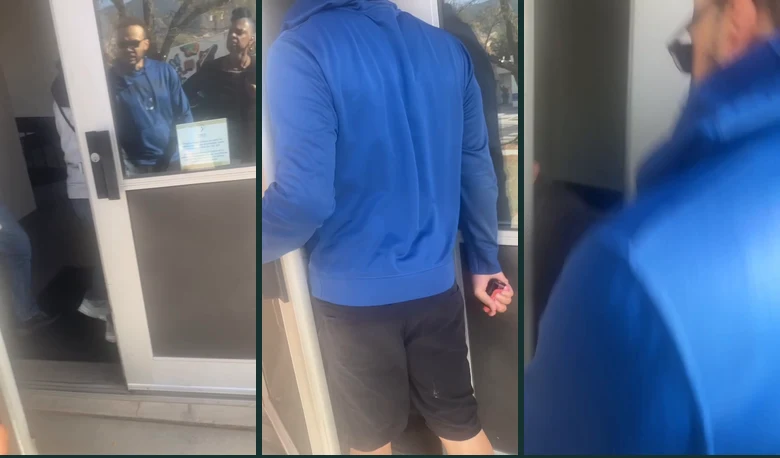
About the supplied video
John Wingo identifies IMG_3771.mp4 as the October 31, 2025 office encounter. The clip has no visible incident clock. Its container creation date is November 26, 2026, which dates this copy. The full-length player preserves the supplied file and its silence. Each Axon player below comes from a separate recording and has its own elapsed time.
An officer repeats who could enter
Axon D01A8351S · file labeled 10:43 · 17:14.10–17:21.10 elapsed
An officer recounts the instruction he gave John Wingo. Listen for “they said you can go in, but your parents can’t.” The excerpt comes from a later conversation between officers.
“Did Dad go inside?”
Same Axon file · 17:56.50–18:15.55 elapsed
A voice says he started to go inside, then adds, “I think security pushed him back out.” Listen through the question about Grandma and Granddad. A speaker also describes watching for several minutes.
Cody Crawford identified himself in his incident report as CPCD’s Director of Facilities. He wrote that he “pushed him backward in the chest” to prevent entry. Crawford also accused John Wingo of subsequently kicking the door. John disputes damaging it. The police disposition lists a property-damage ticket for John and a trespass ticket for his mother. It lists Crawford as a witness and records no ticket for him. As of November 26, John said he was still answering the charge and seeking his son’s complete records.
Read Crawford’s own descriptionRead the written restrictionFollow the cost into court
Which building did the city mean?
John Wingo says there was no school lockdown on October 31 and disputes the claim that his family caused one. John Wingo and his parents, Felicia and Ernest Wingo, went to the administrative office on October 31, 2025. John’s son attended the child development center at Pikes Peak State College. John says the family was never at the school during the Robinson Street encounter and no children were at the office for school during the visit. The city later recorded a different account.
- Where the family had its appointment
- Community Partnership for Child Development
2330 Robinson Street, Colorado Springs, CO 80904. CPCD lists this as its Central Office for administration and enrollment. Its facilities director places the incident at Meeting Room 225 and the main entrance. CPCD office directory - Where the detectives worked
- Safe Passage Children’s Advocacy Center
2335 Robinson Street, across the street. Safe Passage identifies the Colorado Springs Police Department’s Crimes Against Children Unit as an on-site partner. Detectives describe first seeing the CPCD entrance from this side of the street. Safe Passage · fall 2025 - Where John Wingo’s son went to school
- Pikes Peak State College, Centennial Campus
5675 South Academy Boulevard, Colorado Springs, CO 80906. The college lists CPCD at this campus. The sheriff’s October 28 morning dispatch entry gives this address. October 31’s CSPD report gives Robinson Street. College campus directory · p. 4
What became a “school lockdown” in the court file?
Look at the wording at each step. Colorado Springs Police Detective Sean Medina called 2330 Robinson a preschool facility. Detective Whitney Barrett wrote that CPCD staff told her they put the building on lockdown for staff and children. She also recorded that the child attended the college center. At 10:42:28 a.m. the dispatch log for 2330 Robinson Street recorded “BUSN SHILTER IN PLACE” (spelling as entered). Ten seconds earlier the log placed the people involved outside the front door. The next entries relay a caller’s accusation that people were trying to force the doors. CPCD Director of Facilities Cody Crawford wrote that his SAFE team was implementing a lockdown at that building. The March court entry and the two June rewrite forms went further. They attributed a school lockdown to Felicia and John Wingo.
What did staff secure at the office? Who, if anyone, ordered a lockdown at the child’s campus on October 31? The records shown here contain no campus activation time, instruction to teachers or all-clear for that date. The college distinguishes securing exterior doors from a lockdown that calls for interior doors to be locked and occupants to remain out of sight. On October 28, dispatch recorded a report of sheltering at the campus. That was three days earlier. John Wingo asks whoever entered “school lockdown” in his case to identify the address and the source.
Read both city formsPPSC emergency definitionsOctober 31 dispatch · discovery p. 7Read the detectives’ wordingCrawford’s incident report
The records John Wingo requested from the school
John Wingo says he agreed to speech services for his son. When he learned that other adults had been involved in the classroom, he wanted their names, the authorizations they relied on and the notes they kept. The October 13 recording captures the family asking for the file. On October 28, a staff member identified the form she understood a parent had signed. That gave the family a specific document to request. More than a year later, John says he is still seeking the complete records.
At 8:58, a family member asks for copies of anything already documented. The response is “Okay.”
At 2:42–3:02, the conversation turns to who permitted District 12 into the classroom. A staff member identifies the EN103 form and says it should have been uploaded.
John Wingo told police he wanted to know who had been around his son. At the same office, Detective Sean Medina recorded Ernest Wingo raising concerns about earlier injuries of unknown origin. Medina also wrote that Ernest said the child was safe at home and the injuries were unrelated to that day’s incident. The family still wants to know whether anyone made a safety referral and what response followed. Hear John’s request and compare the detectives’ accounts.
Medina’s account · report pp. 8–9The consent and records still requested
What a parent can ask to inspect
For records governed by the Head Start performance standards, 45 C.F.R. § 1303.23(a) gives a parent the right to inspect their child’s records within a reasonable time, up to 45 days after the program receives the request. Section 1303.21 identifies when FERPA or IDEA procedures apply instead. The signed consent form, date of receipt and record custodian matter to this question.
Which records rule applies45 C.F.R. § 1303.23 · parental rights
October 28 · Two addresses, two calls for service
The morning meeting took place at CPCD’s administrative office, 2330 Robinson Street. John Wingo recalls staying there to ask Officer Rogers for help. The dispatch entry opened at 10:10:14 a.m. gives a different address, Pikes Peak State College South, 5675 South Academy Boulevard. At 10:10:45, the log records a report that the child center was sheltering in place. At 10:16:40, the unit said the subject was off scene. Seven seconds later dispatch changed the event from a high-risk disturbance to a non-emergent keep-the-peace call.
The afternoon campus pickup generated a separate call, 2025-00203694. The sheriff’s response to records request 82721 lists radio traffic for the morning incident and 911 audio for the afternoon incident. The morning log does not give the caller’s exact words. These October 28 entries concern the college. The October 31 log concerns a disturbance at the Robinson Street office.
See the morning dispatch entries · exhibit p. 1Compare the meeting and afternoon pickup
October 29 · A request to release the child
A speaker says the child is inside and asks for the child to be released. John Wingo’s working chronology places this exchange at the child-care site. The October 31 police report identifies the later encounter as taking place at CPCD’s Robinson Street administrative office.
Recording 158 · October 29, 2025, 0:13–0:42. For the location, see the October 29 entry in CPCD Unofficial. Read the October 31 office account.
When did police begin watching the family?
John Wingo says he went to Robinson Street on October 31 because CPCD had arranged a meeting about his son’s records. Dr. Shana Lachowicz told Officer Carlos Espinoza that a meeting had been scheduled for the parents and only John could enter that day. Ernest Wingo told Detective Sean Medina the family had a 10 a.m. appointment and that he and Felicia came to support their son. Felicia told Detective Christian Kinsman that CPCD had invited the family and then declined to meet with them when they arrived. The accounts differ on who could go inside.
Read the appointment accounts · report pp. 8, 15–16
“Like 10 o’clock tomorrow” · 6:34.840–6:39.260 in the scheduling call.
“Meet you in person tomorrow” · 10:04.940–10:08.240 in the same call.
How the call is dated
John Wingo’s timeline places the call on October 30. Both excerpts say “tomorrow.” The audio file’s creation tag is October 31 at 9:12 a.m. MDT. It dates the file and cannot independently date the conversation. The October 31 police interviews supply separate evidence of the appointment.
John Wingo recalls police watching for more than an hour while he tried to get answers. The report gives the scheduled meeting time, the security recording displays a time and officers gave times for their own observations. Each measures a different event.
- 9:29–9:45 a.m.
- Time displayed on Safe Passage security footage that Detective Trevor Kenoyer says he reviewed November 4. This is a 16-minute video interval. Its clock has not been synchronized to the dispatch clock.
- 10:00–10:40 a.m.
- The police cover sheet lists an occurrence from 10:00 to 10:39 and a report at 10:40. Ernest Wingo gives 10:00 as the appointment time. None of those entries establishes when an individual officer first saw the family.
- About 10:42 a.m.
- Kenoyer describes hearing the disturbance from across the street at Safe Passage. Kinsman describes initially seeing three people move away from the door. A second Axon camera shows a window view at 10:42:30 and a street view at 10:42:54.
- 11:20 and 11:21 a.m.
- The cover sheet records John Wingo’s serve-and-release time, followed by Felicia Wingo’s one minute later. Eighty minutes elapsed between the scheduled meeting and John’s ticket. Establishing continuous observation requires the original camera files, their clock settings and the officers’ activity logs.
Who put hands on whom? John Wingo says he was assaulted at the door. Espinoza recorded CPCD facilities director Cody Crawford saying that he used his arm to block John, pushed him back outside and then saw him kick the door. Kenoyer described seeing a shove and a kick from across the street. Kinsman said the situation appeared to be calming and that he stepped away from the window as the family started walking away. His body camera was charging when he first went outside. His observations were limited by the time he spent at the window.
Who had permission to enter?
The October 29 letter from Dr. Shana Lachowicz, which identifies her as CPCD’s Child Development Director, is addressed to John and Felicia Wingo. Read the sentence that imposes the restriction. It names Felicia Wingo. It bars her from picking up or dropping off the child, attending CPCD programming and being on CPCD property. The letter places no such restriction on John. Its printed date is October 29. Child Development Supervisor Layna Mendes told Officer Carlos Espinoza that the letter had been issued October 28. Felicia denied receiving it. The records shown here do not establish that Felicia received the restriction directly before police issued her the October 31 trespass citation. CPCD’s current directory lists Dr. Lachowicz as Senior Director of Early Education.
Dr. Lachowicz told Espinoza that John Wingo could attend and initially refused to go in without his parents. Crawford described a later moment when John tried to enter and Crawford pushed him back. Crawford also accused John of kicking the door. Detective Barrett recorded staff’s explanation that they would refuse John entry while they considered him agitated. John says he went in for the meeting and was pushed back outside. He described that contact as an assault. The sequence bears on whether John could enter at the time he tried.
At 12:13 p.m. Mountain time that day, Crystal Olson-Carranza, CPCD’s Enrollment and Outreach Manager, emailed John Wingo that his son’s disenrollment was effective October 31. That was 53 minutes after John’s citation time. The message gives an effective date and no reason. John says he was still waiting for the records that brought him to the office.
Read who the written restriction namesDisenrollment email · selected fieldsCPCD staff directory
Which citation did John Wingo receive? Kenoyer’s supplement describes John Wingo as cited for trespass and damage. Espinoza’s disposition and the issued tickets assign property damage to John and trespass to Felicia. Medina’s supplement discloses assistance from Axon Draft One and says he reviewed and edited the result. The original recording and revision history would show the words available to Medina when he signed it.
Read the doorway accounts by officer and pageSee three time-stamped Axon framesCompare the report with the issued ticket
Earlier body-camera view of the street approach
Listen at the office door
These excerpts come from Colorado Springs Police Department Axon Body 4 exports for October 31. Each player gives the camera identifier and elapsed time in its own file. The audio runs continuously within each excerpt. The audio players omit the picture to protect people in the recording. A separate privacy-masked video shows the door while the speakers discuss the repair. The speaker wearing a camera and the speaker heard by it can be different people.
Where were the classrooms?
Camera D01A8177S · 11:32 export · 03:29.10–03:35.50
Listen for “not around the classrooms.” Compare the remark with the Robinson Street address in dispatch and the college address where John Wingo’s son attended school.
Read the listening notes
A speaker distinguishes the location from the classrooms. This excerpt does not identify that speaker by name or give the status of the college campus.
Who was trespassed, and who was invited?
Camera D01A8351S · 10:43 export · 07:48.60–08:04.50
The interviewer asks who was barred. John Wingo describes what happened when he tried to enter and addresses whether his mother tried to enter.
Read the listening notes
John Wingo says “I can go in the building” and “I got pushed out.” He also says his mother did not try to enter. Compare the conversation with the written October 29 restriction.
Why does 3M come up at a CPCD records meeting?
Camera D01A8351S · 10:43 export · 10:44–10:59
Asked whom he sued, John Wingo answers, “3M Company.” The other speaker repeats the company’s name. The body-camera exchange places the Minnesota litigation in the October 31 conversation in Colorado.
Read the listening notes
The interviewer asks whether John Wingo was charged. John answers, “No, I sued them.” The interviewer asks, “And suing who?” John answers, “3M Company.” The company’s name is repeated. The exchange documents what the speakers said about the litigation at the time.
What did replacing both door sets have to do with this repair?
Camera D01A9291A · 11:34 export · 01:28.50–02:20.50
One voice appears to ask whether $400 is close. The speakers clearly discuss replacing both door sets so they match and ask for a hard quote. Compare that proposal with the internal repair Crawford describes.
Read the listening notes
Voices overlap at the beginning, and the exact first figure is uncertain. Listen for “both these door sets so they match, essentially” and the request for a hard quote. The conversation records an estimate in progress.
More from the cameras · entry, trespass and the officers’ closing conversations
Protection orders after the tickets
Camera D01A8177S · 11:32 export · 01:05.00–01:15.03
After the citations, the conversation turns to restraining or protection orders. Crawford’s incident report also says officers advised CPCD to consider orders against all three members of the Wingo family who attended.
Read the listening notes
The recording documents a discussion about possible orders. It does not establish that a judge issued an order.
Who was told about trespass?
Camera D01A8177S · 11:32 export · 02:48.10–02:54.50
A participant discusses letting others know about trespass. Compare this later conversation with the October 29 letter and Felicia’s statement that she had not received it.
Read the listening notes
This is a post-citation exchange. It cannot establish when or how the restriction was communicated before the appointment.
A second camera captures the argument about entry
Camera D01A8378S · 10:42 export · 04:32.80–04:47.35
John Wingo says he was pushed. The other speaker describes John trying to enter a place that was refusing entry. John replies that he had been told he could go in.
Read the listening notes
This is the exchange at the doorway as recounted on the camera after the physical contact. Crawford gives his own account in writing.
What the officer told John Wingo’s parents
Camera D01A8351S · 10:43 export · 41:09.90–41:18.73
An officer tells Felicia and Ernest Wingo that it sounds as though CPCD invited John and the child’s biological mother. Compare that assessment with what Dr. Lachowicz told Espinoza.
Read the listening notes
The officer describes his understanding of the invitation after speaking with people at the scene. The separate scheduling call is playable earlier on this page.
What John Wingo called “weird”
Camera D01A8351S · 10:43 export · 11:13.80–11:19.00
John Wingo describes being put outside the Minnesota courtroom. Listen to the exchange that follows his reference to the courtroom and note who is speaking.
Read the listening notes
John Wingo uses “weird” about his courtroom experience. This excerpt ends as he continues his account.
An officer explains why he ran out without his camera
Camera D01A9237A · 10:46 export · 00:29–00:49
The recording picks up an officer’s explanation that he ran out in an emergency, followed by a request for the body cameras to be on. Read Kinsman’s separate written account of the camera in its charging port.
Read the listening notes
Listen for “we just ran out” and “I want you to have your body cam.” The camera identifier names the recording device. Several people can be heard by one microphone.
Who got the property ticket and who got trespass?
Camera D01A8351S · file labeled 10:43 · 28:24–28:41.25
The speakers assign the damage allegation to John Wingo and trespass to Felicia. The issued tickets follow that split. Compare it with the supplement describing John as cited for both.
Read the listening notes
The distinction affects whose notice and conduct need to be examined for each charge.
How an officer described the push and the alleged kick
Same 10:43 export · D01A8351S · 28:48.50–29:01.90
A speaker puts the push first and the alleged kick after it. John Wingo disputes damaging the door. Compare the officer’s words with Crawford’s account and the short, silent family video.
Read the listening notes
This is a later description on the body camera. The short family clip does not continuously show the actions described.
The officer’s verified words about going inside are playable beside the family video. John Wingo recalls the wording as “should have gone inside.” In the recording, the officer recounts telling John he could enter while his parents could not.
Compare the amounts with Crawford’s handwritten answerRead who could enterHow the family obtained the camera exports
Two conversations about 3M, minutes apart
Play just the audio or read the exchange
A speaker refers to 3M and something in the past. The words immediately after “3M” are unclear. Another voice refers to a “race discrimination lawsuit” and asks whether it was in Minnesota. Neither exchange mentions a settlement payment or an instruction from the mayor.
What officers recorded, what they paused and how the family obtained the files
John Wingo says the family struggled to obtain the recordings and at times doubted they would ever see them. Colorado Springs Police’s Digital Evidence Management Unit acknowledged John’s April 9, 2026 request on April 15. At 7:43 a.m. the unit declined direct release because the case was open and directed him to municipal discovery. Five minutes later, it said counsel had to make the request if he was represented. Two copies of the 11:32 export were in the family archive by May 16. The first delivery date remains unresolved.
Detective Christian Kinsman wrote that his camera was charging when he first went outside. Detective Whitney Barrett wrote that she paused her recording to confer with the other detectives about next steps. Officer Carlos Espinoza wrote that he did not review his body-camera footage to prepare his initial report. The family asks what each camera captured of the doorway and whether an independent record exists of the conversation during Barrett’s pause.
John Wingo believes the material the family received was altered. The two archived 11:32 copies match byte for byte. Testing for a change before delivery requires the agency master, the Axon evidence ID, the export and redaction history, and a comparison with the version Internal Affairs reviewed. The copies labeled 11:32, 11:34 and 11:35 each open with about 29 seconds of near-silence on the main audio track. The second tracks are effectively silent. An examiner would need the original activation and buffering settings and audit history to explain that pattern. The available copies leave intentional alteration unverified. Colorado’s body-camera law addresses activation, tampering and permitted privacy edits.
April correspondence and archive datesRead Kinsman, Espinoza and BarrettC.R.S. § 24-31-902
What did Internal Affairs review?
On September 2, 2026, Colorado Springs Police Lieutenant Owen Scott sent John Wingo the outcome of Internal Affairs case 26-0220, opened after John’s June 11 complaint. The commander reported reviewing the investigative memo and relevant portions of the case report and body-camera footage. The letter lists Officers Carlos Espinoza, Ryan Kelley, Trevor Kenoyer, Christian Kinsman and Sean Medina. It classifies the issues it reviewed as exonerated or unfounded and calls the officers’ force lawful and within policy.
The commander addressed how police directed people apart and to the ground. John Wingo’s account of being pushed at the doorway concerns a CPCD employee before that police contact. The letter gives the department’s answer about its officers. John still seeks the recording identifiers and time ranges the reviewer examined, the disposition of the child-safety concern and the evidence the city used for the separate school-lockdown entry.
One ticket number, two courts
How the door acquired three different figures. On October 31, an officer recorded a $1,000 repair estimate. On the 11:34 Axon export (D01A9291A), speakers considered replacing both door sets so they would match and asked for a firm quote. Crawford later described an internal repair costing under $500. The March 23 city court entry gave approximately $500. The county summons subsequently used $1,000, the amount already present in the original police report.
John Wingo believes the matching-door discussion and the talk of a possible felony show an effort to increase the charge. The sequence raises a narrower question officials can answer with records: who supplied the original estimate, what work did it cover, and which document supported using it again after the internal repair? The recorded proposal, the reported repair and the amount entered on a summons describe three different things. The speakers do not identify an agreement to falsify a figure.
Door replacement discussion · Discussion of a possible felony · Crawford’s account · Dispatch and rewrite records
Start with E1481688. Officer Carlos Espinoza cited John Wingo on October 31, 2025. The Colorado Springs Municipal Court opened case 25M35018 on November 2. John’s mother, Felicia Wingo, received a separate trespass citation, E1481689. The court file now contains a transfer form for each of them.
Municipal court
March 23, 2026
The case face sheet lists city property damage under § 9.6.101. On page 2, the clerk’s entry records a rewrite request for review of interference with school under C.R.S. § 18-9-109. It gives an approximate repair bill of $500.
El Paso County Court
June 22 → July 24, 2026
The summons marked REWRITE records service on June 22 and filing on July 24 in case 2026M5068. It charges criminal mischief under C.R.S. § 18-4-501, estimates $1,000 in damage and leaves the second charge field blank.

Two municipal transfer forms, the same lockdown allegation
On June 22, 2026, the city prepared a separate Case Re-Write for each of them. Both forms list a transfer to county court and the same data-entry account. Both request review under Colorado’s school-interference statute. Compare the charge field and the reason field on each form.
City ticket E1481688. The transfer form lists criminal mischief, § 18-4-501. Its reason field attributes a school lockdown to John and Felicia Wingo and refers to an approximate $500 repair bill.
 John’s transfer form · discovery p. 41
City ticket E1481689. Felicia Wingo’s transfer form lists third-degree criminal trespass, § 18-4-504. After attributing a lockdown to both Felicia and John, the reason field adds “Exceeds municipal court resources.”
 Felicia’s transfer form · discovery p. 46
What the facilities director said the repair actually cost
Colorado Springs Police Officer Carlos Espinoza wrote that he obtained a $1,000 repair estimate. He did not identify the person who supplied that figure. CPCD Director of Facilities Cody Crawford then answered a different question on the city’s restitution form. The maintenance specialist had finished the work. Crawford wrote that the internal cost, including time and labor, was under $500. The city’s request for that information is dated November 20, 2025. It bears a date separate from Crawford’s handwritten answer.
Read the video dialogue
A participant says the panel could probably be replaced, then describes the frame. Part of that description is unclear. The speaker proposes replacing “both these door sets so they match, essentially.” Another person asks, “Are you able to get, like, a hard quote from someone?” The reply indicates it would take a couple of days.
Read question 3 and the response. The form asks about actual costs when the work is complete and estimates when it is still outstanding.
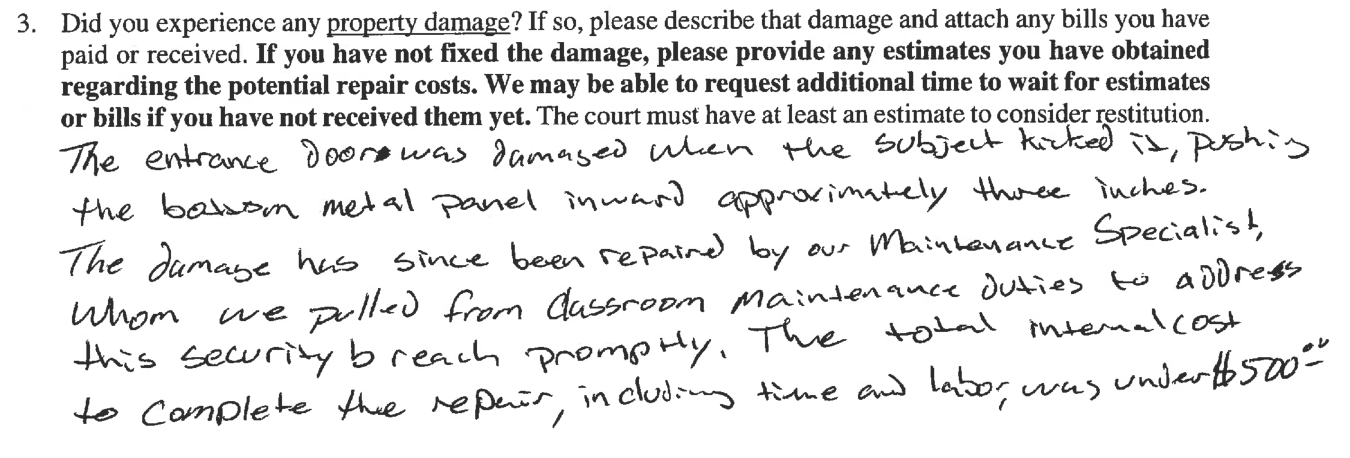 City’s restitution request and Crawford’s response
The source photograph carries an October 31, 2025, 11:07:52 a.m. MDT timestamp. Light is visible at the edge of the lower panel. A photograph by itself cannot assign responsibility or value the repair.
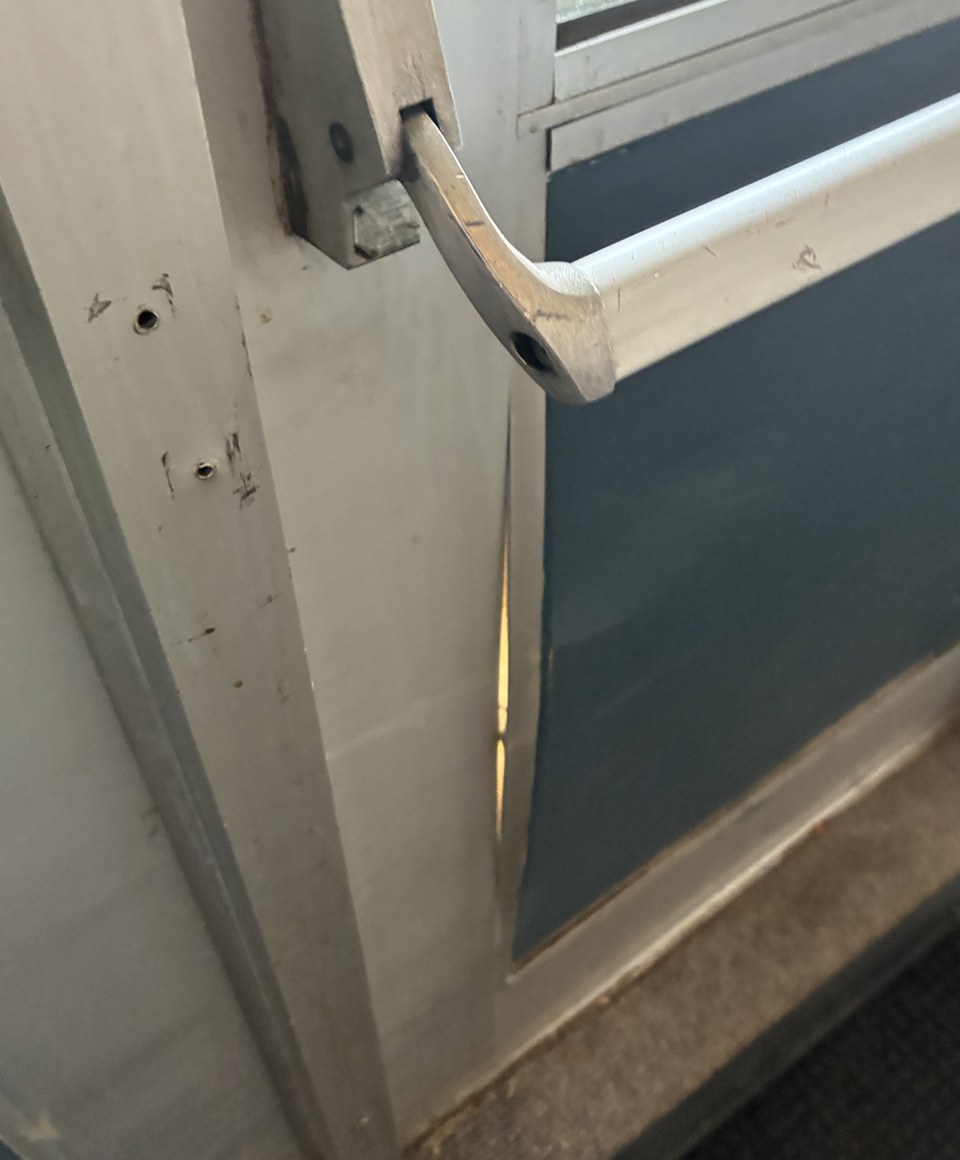
The numbers do different jobs. The October 31 city ticket estimates $1,000. Crawford reports a completed repair under $500. The March 23, 2026 municipal entry and June 22 rewrite give approximately $500. The county summons served June 22 and filed July 24 again gives $1,000. John Wingo asks who supplied the number on the summons, whether that person had Crawford’s answer and what costs justified returning to the higher figure. A maintenance work order and dated charging referral could help resolve those questions.
Why the address, the amount and the author matter under Colorado law
School interference. The city requested review under C.R.S. § 18-9-109. In People in the Interest of C.F., the Colorado Court of Appeals held that subsection (2) requires proof of where the person acted. The law also covers certain buildings used by an educational institution and interference with staff. The address, how the building was used and whose work was impeded are material. John’s county summons shown here lists criminal mischief.
Property damage. C.R.S. § 18-4-501 requires knowing damage to someone else’s property. Under the statute applicable on October 31, 2025, damage from $300 to less than $1,000 falls in the class 2 misdemeanor range. Exactly $1,000 reaches the class 1 misdemeanor range. The first felony range begins at $2,000. Crawford’s “under $500” gives no exact total. The amount matters separately from whether John did the damage at all.
Hear why the amount came up at the door. The 11:32 export, camera D01A8177S, elapsed 04:22.10–04:29.10, captures the discussion of a possible felony at a higher value. John’s county summons displays $1,000.
A false entry in an official record. C.R.S. § 18-8-114(1)(a) covers knowingly making a false entry in, or falsely altering, a public record. The different descriptions warrant a direct question. What did the person responsible for the rewrite know about the location and the completed repair when the entry was made? The dated source sent to the court, the approval and the maintenance record would help answer it.
School interference · § 18-9-109C.F., 2012 COA 75, ¶¶ 15–20Criminal mischief · § 18-4-501Public records · § 18-8-114
Both June 22 forms show the municipal cases as open when the entries were made. John Wingo understood that the city would dismiss his case once he was served. The later county filing is documented. He still seeks the final municipal disposition, the prosecutor’s authorization and the decision addressing the lockdown allegation. The shared data-entry account does not identify the official who approved the charges.
Read the three damage entries · exhibit p. 3
Compare the city ticket and county summonsRead the service and filing dates
Why John Wingo disputes the basis for the charge
The police report documents the appointment and John Wingo’s request for his child’s records. It also records a staff member’s account of pushing John. John left with a ticket. As of November 28, 2026, John says he still does not have his son’s complete records. Read his update and the investigator’s request. His first question is what became of the child-safety concern while police investigated the family.
The city’s register gives review of a school-interference allegation as the reason for the rewrite. The county summons lists criminal mischief. John Wingo’s original ticket and county summons give $1,000. The facilities director reported that CPCD completed the repair for under $500. Police accounts differ on who was accused of trespass. John disputes the charge and denies damaging the door. He believes the charging process was abused and asks for an investigation into possible fraud in the paperwork. An investigator could check the entries against the original video, invoice and instructions accompanying the referral.
John Wingo believes the encounter at the administrative office was arranged under false pretenses. He cites the recorded invitation, Crawford’s written account of the push and the school-lockdown allegation on both transfer forms. Crawford reported a repair cost less than half the $1,000 entered on John’s county summons. John seeks communications showing when the lockdown explanation first appeared and who transmitted it. He relates these concerns to the Minnesota docket, which attributes a joint signature to him where the pages show two lawyers’ names. John asked Colorado officials to investigate those lawsuits. Later, he faced a charge arising from the visit for his child’s records and heard people in public roles discuss a settlement. John says he received no payment. He asks who first reported a payment, who repeated the claim and what happened to any funds issued in the plaintiffs’ names.
When John Wingo says “protect the Democrats,” he is describing what he hears in the Minnesota recording and his interpretation of the later events. He believes the family was targeted and his requests were pushed aside to protect people with influence. He asks investigators to identify who handled his July 14 request at the mayor’s office, who approved the rewrite, where the settlement account originated and who received any disbursement. Those records could help establish whether the events were connected or anyone received money owed to the plaintiffs.
Compare the signature pagesListen to the closed-session passageRead the rewrite entryHear the offer and payment accounts
Mayor Yemi Mobolade, CPCD’s SAFE team and the detectives across the street
John Wingo recalls meeting Yemi Mobolade at a Colorado Springs coffee shop with his family, giving him papers about the plaintiffs’ 3M cases and leaving with the expectation that he would help. On July 14, 2023, while the suits were pending, John followed up with Mobolade’s campaign contact at 1:33 p.m. and his city office at 1:39 p.m. John sent the federal docket link, referred to their meeting and requested another meeting and a public statement. The correspondence documents when he brought the cases to the mayor’s office.
John Wingo believes the treatment his family later received was retaliation. He asks who handled those emails and whether city officials communicated about the family with police, CPCD or prosecutors. The mayor’s office, CSPD, the city prosecutor and the state’s Fourth Judicial District Attorney’s Office had different responsibilities. El Paso County Court received the later filing. The records shown here identify no instruction from Mobolade to charge the Wingos. An intake log, referral or dated instruction could help establish whether any connection existed.
Read the two July 14 messagesHear how police handled John Wingo’s earlier complaint
Three groups appear in this record. Crawford identified the SAFE team as the group he asked to secure the Robinson Street office. He described detectives at Safe Passage as people who had reportedly been monitoring the situation. CSPD identifies detectives assigned to Crimes Against Children at Safe Passage. Officer Espinoza recorded that detectives were already on a separate call for service. The city budget also describes a mayoral protective security function. These records establish the first two groups’ presence or reported actions. They identify no instruction from the mayor’s office. John Wingo seeks the SAFE team’s activation log, the other call number, the detective assignments and any communication with the mayor’s office naming the Wingos. Those records could help test his allegation of coordinated retaliation.
Mobolade’s trial testimony and the business lawsuits
In April 2023, a cross was burned in front of Mobolade’s defaced campaign sign. A federal jury convicted Derrick Bernard Jr. and Ashley Blackcloud in May 2025. Mobolade testified about learning of the incident the next morning. Bernard later accused Mobolade of advance knowledge. At sentencing, Judge Regina Rodriguez said the jury had rejected Bernard’s account. Bernard received 46 months on April 1, 2026. The mayor appeared as a witness. The verdicts were against Bernard and Blackcloud.
Justice Department · verdictsKOAA · testimony at trialAssociated Press · claim and judge’s response
Two separate civil suits concerned unpaid supplier bills at Wild Goose Meeting House and Good Neighbors Meeting House. In April 2024, Colorado Public Radio reported that Shamrock Foods sought nearly $29,000 and $68,000, respectively. Mobolade denied responsibility and pointed to his former business partner. In December 2024, The Gazette reported that the suits had been dismissed. Those disputes concern restaurant bills. Tracing any payment in the 3M cases requires the records of those cases.
Reports of threats, an FBI reference and a disputed settlement account
The Wingo family reported gunfire and photographed shattered vehicle glass. The family also saved messages it understood as warnings, including the exchange displayed under the name “Regina Guy-English.” John reports being watched and encountering people who identified themselves as FBI personnel. Their identities remain unverified. A separate recording documents what Officer Levi G. Braun said in June 2024. He recommended contacting the Denver FBI office and said he had no evidence at the time that John Wingo’s phone was actively being tracked. John asks that the incident assignments, dispatch records and follow-up findings be compared with the times the family reported.
In July 2024, John Wingo sought help from Braun, Robert Koski of the Fourth Judicial District Attorney’s Office and Colorado State Senator Tony Exum Sr. Later, congressional aide Jeff Anderson described an offer he had heard about. In a separate recording, public defender Dillon Taunton spoke as though John Wingo had received a settlement. The recording captures the family’s immediate response. John says he received no settlement payment. An agreement, trust ledger or disbursement identifying a recipient could clarify whether any payment was made. The source of the information remains unknown.
See the damage photographsRead the messages in contextHear Anderson and Taunton
In the congressional-office conversation Anderson describes what he had heard about an offer. The excerpt begins at 0:11.9.
At about 0:29–0:44 of a separate defense meeting, Taunton says it appeared John Wingo received a settlement. Listen for the family’s immediate “No.”
Why John Wingo asks who gets heard in court
John Wingo says he was outside the Minnesota courtroom when the judge asked the plaintiffs’ lawyer about the truth of their complaints. John hears “protect the Democrats” in the recording. His family took the recording to Atlanta. In the separate Georgia YSL prosecution, a meeting held without defense counsel later became a matter of public record. In Colorado, John recalls appearing by Webex on September 10, 2026. Participants in the recorded defense meeting discuss a hearing on “the 10th.” John also reports that people trying to observe proceedings were kept out. He seeks the hearing notice, attendance log, minute entry and any order restricting access to establish who was admitted, by whom and on what grounds.
John Wingo believes political protection helps explain why the plaintiffs’ complaints went unanswered. Testing that belief requires identifying who made each decision in each court. The records shown here establish specific meetings, statements and filings. Establishing coordination across the three states would require evidence connecting the decision-makers.
Hear the Minnesota exchangeRead the Georgia court recordHear the discussion of “the 10th”
What the Tina Peters decision shows about proof of retaliation
In a separate Colorado case, the Court of Appeals upheld Tina Peters’s seven convictions and reversed her sentence. The court examined the sentencing judge’s own remarks and concluded that the sentence punished Peters in part for protected speech. The governor later commuted her sentence, and she was released on parole June 1, 2026. The Colorado Supreme Court denied her petition for review on September 21.
John Wingo cites the ruling because the appeals court could point to what the decision-maker had said. In his case, he points to the city’s written reason for the rewrite. He asks who supplied the lockdown account, what footage that person reviewed and whether anyone discussed his 3M testimony when making the decision. Those records could help an independent reviewer evaluate his concern that he faced consequences for speaking out.
People v. Peters, 2026 COA 24, ¶¶ 140–149Colorado Supreme Court · 26SC332Colorado Public Radio · release on parole
What an independent observer can document
John Wingo asks members of the public to attend open hearings and hear the proceedings firsthand. Check the date, division and attendance instructions with the El Paso County clerk before traveling. Anyone who witnessed a proceeding or was turned away can record the date, courtroom and instructions received so an investigator can check the details. Keep children’s names, school files and private contact details out of public submissions.
Anyone with original continuous footage, a lockdown directive, a child-safety referral number, a signed disposition, a repair invoice or a record of disbursement can identify the issuing office and page when contacting the plaintiffs. Those details would help establish what the underlying records show.
Official county docket and access informationEl Paso County clerkChapter 8 · submit a source or firsthand observation
Source guide · The working timeline CPCD Updated 4/27 (27.pdf, pp. 28–32, 58–66 and 74–77) and CPCD Unofficial (pp. 7–13) identify the events the family wants reviewed. The recordings, agency entries and court excerpts above show the records behind those passages. Personal details about the child have been omitted from the exhibits.
ARCHIVE UPDATE · NOVEMBER 24, 2026
How Updates Are Dated and Sourced
This page is updated by the project. Each entry identifies what changed and links back to its source; it is not an automatic court docket feed.
Latest Changes to the Case Archive
Clearer Navigation and Source Comparisons
The header places First Appearance at the left and Case Index at the right. Bold headings and light outlines make it easier to see which testimony and sources belong together.
The Cornwell records and excerpt are now in the Colorado chapter. The phone-copy chronology puts the disputed notice dates side by side, and the July 20 filing comparison shows the docket entry alongside the signature pages.
This is an archive update, not a new court notice. Existing testimony, documents and recordings remain available.
November 22, 2026
New Routes into the Case Record
Start with the homepage introduction, then open the dated timeline. The newsroom links the reporting to its original publishers and video channels. The legal guide identifies the rules relevant to each issue.
NOVEMBER 20, 2026 · MCCOLLUM DECISION & STATUS DISPUTE
The Paralegal Description and the Supervised-Practitioner Account Disputed by John Wingo
Cornwell & Counsel now compares the October 2023 OLPR letter, the newly supplied McCollum determination and Cornwell’s later response. John Wingo maintains that Cornwell was a paralegal and disputes the memorandum’s claim of supervised-practitioner status. The update quotes the decision’s acknowledgment of evidence of misconduct and its separate treatment of possible unauthorized practice as an allegation not considered.
This is a source-analysis update, not notice of a new court finding or enforcement action. Read the decision comparison, John Wingo’s account and the source-page guide.
NOVEMBER 20, 2026 · SUBJECT ORGANIZATION
How the Navigation Changed in This Update
At the time of this update, the main header had nine direct links. Cornwell & Counsel, Colorado Events and Settlement Questions each have their own subject page. News reporting, interviews and project films are together in News & Media. The October 13 hearing keeps its recordings, complete supplied captions, testimony and transcript together.
The home page and original source files are preserved. Earlier page addresses and source anchors remain available. This is an unlaunched working preview.
NOVEMBER 20, 2026 · HEARING VIDEOS & SOURCE UPDATE
Two October 13 Excerpts, Now Captioned and Organized
The 1:01 phone-data video and 2:52 privilege discussion now have private viewing links on the hearing page. Read all 57 timed passages, the key exchanges, the public-record context and questions raised by John Wingo in one place.
NOVEMBER 20, 2026 · ARCHIVE UPDATE
Court Documents and Recordings Added to the Records Index
Court documents and all 30 catalog entries are now organized in one Records hub, with short source descriptions and expandable detail.
NOVEMBER 20, 2026 · MEDIA UPDATE
Voices, Coverage, and Photographs
The detailed reporting, recording excerpts, and firsthand accounts are now collected in Testimony & Events. Photographs, historical artwork, and project films remain in Media & News.
NOVEMBER 20, 2026 · DESIGN UPDATE
Changes to the Site Navigation
Six main tabs, a prominent site title, and original 3D motion create room for the sources and the people behind them. Testimony & Events now brings personal accounts, detailed reporting, and the chronology together.
Court Hearings and Notices
NEXT HEARING · AWAITING A VERIFIED NOTICE
No New Federal Hearing Date Has Been Verified for This Page.
A dated court notice or order is needed before a future hearing is listed. When one is available, the entry will show the case number, court, date, time zone, location or official access instructions, and the source link.
The GovInfo collection contains published opinions and is not a complete live docket. The linked July 17, 2024 order records the dismissal of the six complaints with prejudice for failure to prosecute.
Earlier Proceedings & Orders
OCTOBER 13, 2023
Counsel-Withdrawal Hearing
The certified public transcript records the proceedings and omits the closed discussion.
DECEMBER 18, 2023
Discovery & Scheduling Order
The written order provides the source for the court’s discovery directions.
For Colorado matters, use the separate Colorado records page. A date from another case will not be presented as a hearing in Wingo v. 3M.
Support and media contacts
The Closing Statement lists the project contact, witness submissions and official oversight routes. The original “Stand With Us!” flyer is preserved there. The News & Media chapter holds the interview photograph and the original coverage.